Table of Contents
ToggleThe entryway sets the tone for every home. It’s the first space guests see and the last one homeowners pass through before heading out. A modern entryway balances function with clean aesthetics, storage that doesn’t clutter, lighting that makes a statement, and finishes that feel deliberate. Whether working with a cramped 3×5 alcove or a generous foyer, the principles remain the same: edit ruthlessly, prioritize what gets used daily, and let materials do the heavy lifting. This guide walks through the core elements of contemporary entryway design, from minimalist storage to strategic lighting and the furniture pieces that earn their square footage.
Key Takeaways
- Modern entryway design balances clean aesthetics with functional storage, strategic lighting, and intentional material choices that serve daily living without clutter.
- Wall-mounted modular storage systems and bench seating with hidden compartments maximize space while keeping essentials accessible in contemporary entries.
- Contemporary lighting—including pendant fixtures, linear chandeliers, and smart controls—transforms the entryway into an architectural focal point rather than an afterthought.
- Neutral color palettes, durable flooring (porcelain tile or engineered hardwood), and high-quality materials like white oak and concrete create lasting visual impact with minimal upkeep.
- Every furniture piece and decorative element must justify its footprint; choose multifunctional items like mirrors, console tables, and coat racks that enhance both form and function.
- Edit decor ruthlessly by limiting artwork to one large-scale piece and keeping decorative objects to odd-numbered groupings to maintain the uncluttered, welcoming feel essential to modern entry design.
What Defines Modern Entryway Design
Modern entryway design strips away the decorative excess common in traditional foyers. It favors clean lines, neutral palettes, and uncluttered surfaces. Materials lean toward natural or industrial finishes: white oak, concrete, steel, stone.
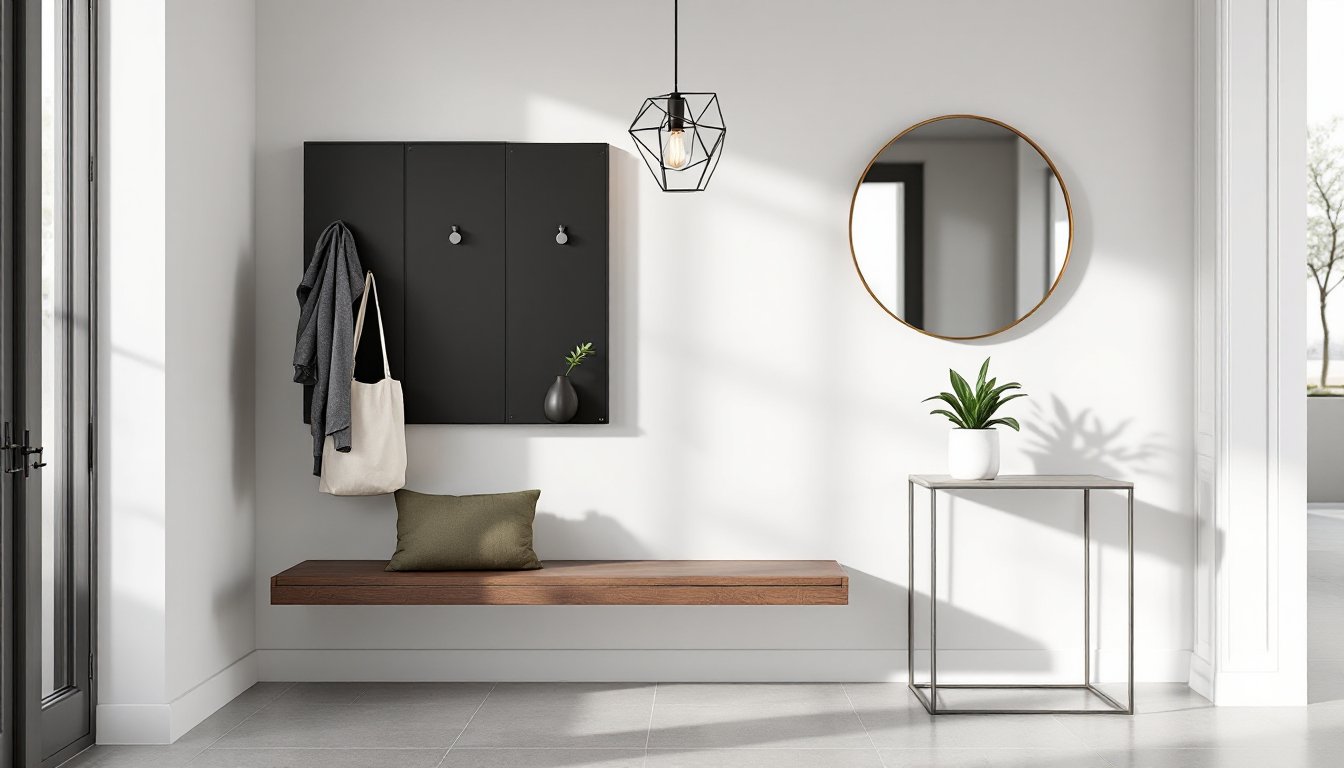
Functionality drives every choice. A modern entry doesn’t feature a delicate console table that can’t hold keys, it includes purpose-built storage that hides shoes, charging cables, and dog leashes. Benches have lift-up seats or slide-out drawers. Hooks are integrated into wall-mounted panels rather than surface-screwed into drywall.
Lighting becomes architectural. Recessed cans give way to pendant fixtures with geometric forms or linear LED strips. The goal isn’t ornament, it’s clarity and impact.
Open sightlines matter. Modern layouts avoid visual barriers between the entry and adjacent rooms. That means fewer privacy walls and more transparent partitions or open thresholds. If the entryway opens to a hallway, flooring often continues without transition strips to maintain flow.
Color schemes stay tight. Whites, grays, blacks, taupes, and occasional warm woods dominate. Accent colors appear sparingly, a single olive-green bench cushion or a charcoal runner. The restraint keeps the space from feeling busy, especially in smaller footprints where every element competes for attention.
Minimalist Storage Solutions That Maximize Space
Storage makes or breaks an entryway. Modern solutions hide clutter while keeping essentials within arm’s reach.
Wall-mounted systems anchor the approach. Modular panels with integrated hooks, shelves, and magnetic strips eliminate the need for freestanding furniture. Install them directly into wall studs using #10 wood screws at 16-inch intervals for load-bearing stability. Look for systems with powder-coated steel or solid hardwood, MDF warps under humidity near exterior doors.
Floating shelves offer display space without visual bulk. Mount them with heavy-duty bracket systems rated for at least 50 pounds if they’ll hold bags or bins. Keep depth to 8-10 inches to avoid encroaching into walkways. White oak or walnut veneer over plywood core balances durability and aesthetics.
Bench seating with hidden compartments handles shoes, umbrellas, and seasonal accessories. Many contemporary furniture pieces feature hydraulic lift mechanisms that prevent lid slam. Size the bench to fit the wall width, 48 inches works well in standard 5-foot-wide entries. Upholster in contract-grade fabric (30,000+ double rubs) if kids or pets will use it daily.
Coat closets can be retrofitted with slimline organizers. Replace a single hanging rod with double rods at 40 inches and 80 inches to maximize vertical space. Add pull-out shoe racks on the floor and overhead shelves at 84 inches for off-season storage. If the closet door swings into the entry, consider replacing it with a sliding barn door or pocket door to recover clearance.
Cubbies and lockers work in family-heavy households. Assign each person a cubby (roughly 12×12×15 inches) for daily items. Build them from ¾-inch plywood with dados cut for shelves, glue and brad-nail the joints, then finish with low-VOC paint or clear poly. Label cubbies with minimal metal plaques or vinyl lettering to keep the look clean.
Statement Lighting for Contemporary Entryways
Lighting defines mood and function in modern entryways. Forget the builder-grade flush-mount dome, contemporary fixtures command attention.
Pendant lights work best in entries with 8-foot ceilings or higher. Hang them so the bottom sits 6.5 to 7 feet above the floor to avoid head strikes. Choose fixtures with exposed Edison bulbs, geometric metal cages, or sculptural glass. Wire them to a dimmer switch for flexibility, LED-compatible dimmers prevent the flicker common with cheap units.
Linear chandeliers suit wider foyers. A 36-inch fixture fits entries up to 6 feet wide: go to 48 inches in spaces 8 feet or wider. Mount centered over the walkway, not off to one side. Black or brushed brass finishes integrate well with neutral palettes.
Wall sconces add layers without taking floor space. Flank a mirror or artwork with two sconces at 60-66 inches to center height. Choose backplate styles that mount flush to the wall. Hardwire them during a remodel, or use plug-in versions with the cord tucked inside paintable cord covers.
Recessed lighting remains useful for general illumination. Space 4-inch or 6-inch cans roughly 4 feet apart in a grid. Use 3000K LED bulbs for warm white light that doesn’t skew clinical. Adjustable trims let occupants direct light toward artwork or architectural details.
Safety note: All wiring must comply with NEC Article 210 for branch circuits. If adding new circuits or replacing fixtures in older homes, verify grounding and use GFCI protection if the entry is near exterior doors subject to moisture. Hire a licensed electrician if unfamiliar with load calculations or local code.
Controls matter. Install motion-sensor switches or smart switches so lights activate automatically when entering with arms full of groceries. Link them to home automation systems for scheduling and remote control.
Color Palettes and Materials in Modern Entry Design
Modern entryways rely on a limited palette and high-quality materials to create impact without clutter.
Paint colors stay neutral. Benjamin Moore’s Chantilly Lace (a clean white), Sherwin-Williams Repose Gray (a soft gray with warm undertones), or Farrow & Ball’s Railings (a near-black charcoal) serve as go-to choices. Use satin or eggshell finishes for walls, they hide minor imperfections better than flat and clean easier than gloss. Prime all drywall with a stain-blocking primer if the entry gets direct sun or sits near an exterior door prone to condensation.
Flooring must handle dirt and moisture. Porcelain tile in large-format planks (12×24 inches or larger) mimics wood but resists water and scratches. Set tiles with ⅛-inch grout lines using unsanded grout for tight joints and sanded grout for anything wider. Seal grout annually to prevent staining.
Engineered hardwood works if the entry isn’t exposed to standing water. Choose planks with a wear layer of at least 3mm and a urethane finish rated for commercial traffic. Avoid solid hardwood near exterior doors, seasonal humidity swings cause cupping.
Concrete makes a bold statement. Polish existing slabs with diamond-grit pads up to 1500 grit, then seal with a penetrating lithium silicate sealer. For overlays, consider micro-topping at ⅛-inch thickness troweled over the existing surface. Concrete stains or dyes add subtle color variation without masking the material’s texture.
Wall treatments add depth without pattern. Shiplap installed horizontally with a ⅛-inch reveal between boards creates texture in a monochrome scheme. Use 1×6 pine or poplar boards, prime all sides before install, and attach with finish nailers into studs. Venetian plaster or limewash paint introduces organic variation that still reads as neutral.
Accent materials include metal, glass, and stone. Incorporate these elements that align with broader interior design trends through hardware, mirrors, or trim details rather than large surfaces.
Functional Furniture Pieces for Stylish Entries
Every piece in a modern entryway must justify its footprint. Choose furniture that multitasks and fits the scale of the space.
Console tables provide a landing spot for keys, mail, and bags. Stick to depths of 12-14 inches in tight entries to preserve walkway clearance. Look for designs with lower shelves for baskets or shoes. Solid wood or metal frames outlast particle board. If mounting a wall-mounted console, anchor it into at least two studs with heavy-duty brackets rated for the expected load.
Benches make shoe changes easier and offer concealed storage. A 16-18 inch seat height suits most adults. Add a 2-inch foam cushion wrapped in fabric for comfort. For DIY builds, construct the frame from 2×4 framing lumber with a ¾-inch plywood top. Attach piano hinges for lift-up lids and add soft-close lid supports to prevent finger pinches.
Coat racks can be freestanding or wall-mounted. Freestanding designs need a weighted base or wall tether to prevent tipping. Wall-mounted racks should use toggle bolts or screw into studs to support heavy winter coats. Space hooks 6 inches apart for adequate clearance.
Mirrors visually expand small entries and provide a last check before heading out. Mount them at eye level (around 60 inches to center) and ensure they’re secured with mirror clips or D-rings and wire rated for the mirror’s weight. Frameless options with beveled edges suit minimalist aesthetics, while metal-framed mirrors add industrial contrast.
Umbrella stands corral wet umbrellas without drips spreading. Choose models with drainage holes and removable liners. Metal or ceramic versions last longer than plastic.
Shoe cabinets with slatted doors or perforated panels allow airflow to prevent odor buildup. Tilt-out designs take up less floor space than swing-door cabinets. Size them to hold at least 12 pairs for a household of four, using shelves angled at 30-45 degrees.
Adding Personality With Art and Decor
Modern design doesn’t mean sterile. Strategic art and decor add character without clutter.
Artwork introduces color and focal points. A single large-scale piece (36×48 inches or bigger) makes more impact than a gallery wall in tight quarters. Hang it so the center sits at 57-60 inches from the floor, the standard museum height. Use picture-hanging wire and two D-rings on the back, secured to wall studs or drywall with wall anchors rated for at least 50 pounds.
Mirrors double as decor and function. Oversized round mirrors in matte black frames add geometric contrast against rectilinear walls. Lean mirrors against the wall on consoles for a casual look, but tether them with earthquake putty or L-brackets to prevent tipping.
Plants soften hard finishes. Choose low-maintenance varieties like snake plants, pothos, or ZZ plants that tolerate low light and irregular watering. Use planters with drainage saucers to protect flooring. Avoid placing plants directly in front of HVAC returns where dry air wilts foliage.
Runners and rugs define the entry zone and trap dirt. Choose low-pile synthetic rugs or flatweave natural fiber options that vacuum easily. Size the runner to leave 4-6 inches of exposed floor on each side. Secure it with double-sided rug tape or a non-slip pad to prevent tripping.
Decorative objects should be edited down. A ceramic bowl for keys, a sculptural vase, or a single coffee table book suffices. Resources like Homedit showcase curated examples of how minimal decor maintains visual interest. Group objects in odd numbers (one or three items) for balanced compositions.
Hooks and hardware become design elements when chosen intentionally. Matte black, brushed brass, or polished nickel finishes tie into lighting and plumbing fixtures elsewhere in the home. Wall-mounted hooks with sculptural profiles serve as art when not in use.
Seasonal swaps keep the entry fresh. Rotate artwork, swap pillow covers, or change out plants quarterly. Limit these updates to one or two elements so the space doesn’t feel constantly in flux.
Conclusion
Modern entryway design succeeds when it balances aesthetics with the realities of daily use. The strategies outlined here, from minimalist storage systems to deliberate material choices and functional furniture, create entries that remain uncluttered and welcoming. Publications like Design Milk continue to document how contemporary design evolves, but the fundamentals hold: edit ruthlessly, build for durability, and let quality materials and smart lighting define the space. Whether starting from scratch or updating an existing entry, these principles adapt to any footprint or budget.