Table of Contents
ToggleGerman kitchen design has earned a reputation for precision, innovation, and timeless style, qualities that resonate with homeowners who want a kitchen that works as hard as it looks good. These aren’t just pretty cabinets with fancy hardware. German kitchens represent a philosophy where engineering meets aesthetics, where every drawer glides on ball-bearing rails and every corner is optimized for function. If the goal is to upgrade a kitchen beyond basic box-store cabinetry, understanding what sets German design apart can help shape a renovation that delivers lasting value and daily satisfaction.
Key Takeaways
- German kitchen design prioritizes engineering and precision over aesthetics alone, using 18mm thick cabinet boxes, soft-close drawer systems rated for 80,000+ cycles, and modular metric-based sizing for a seamless fit.
- The minimalist aesthetic of German kitchens features handleless cabinets, integrated appliances, clean horizontal sightlines, and matte or high-gloss lacquer finishes that avoid trendy elements and age gracefully.
- German kitchens incorporate advanced storage solutions as standard, including pull-out pantries with full-extension slides, corner carousels, and drawer dividers that maximize functionality without visual clutter.
- Authentic German kitchen design requires investing in superior hardware—European-style hinges, full-extension soft-close drawer systems, and touch-to-open mechanisms—which cost 20-30% more but deliver lasting durability.
- Neutral color palettes (white, gray, black, taupe) combined with engineered quartz or large-format porcelain countertops and minimal-grout flooring create the signature cohesive, timeless look of German kitchen design.
- To maximize impact, choose a cohesive material palette and prioritize quality hardware and cabinetry over square footage, as a small, well-executed German kitchen outperforms a sprawling poorly planned alternative.
What Makes German Kitchen Design Unique?
German kitchens prioritize function over flash. The defining trait is an almost obsessive attention to engineering: cabinets are built with 18mm thick cabinet boxes (not the 12mm particle board common in budget lines), drawer systems use soft-close mechanisms rated for 80,000+ cycles, and hardware is tested to withstand decades of daily use.
Another hallmark is modularity. German manufacturers design in metric increments, often 150mm or 300mm wide, allowing cabinets to fit together like precision-cut puzzle pieces. This makes it easier to customize layouts without gaps or filler strips that cheapen the look.
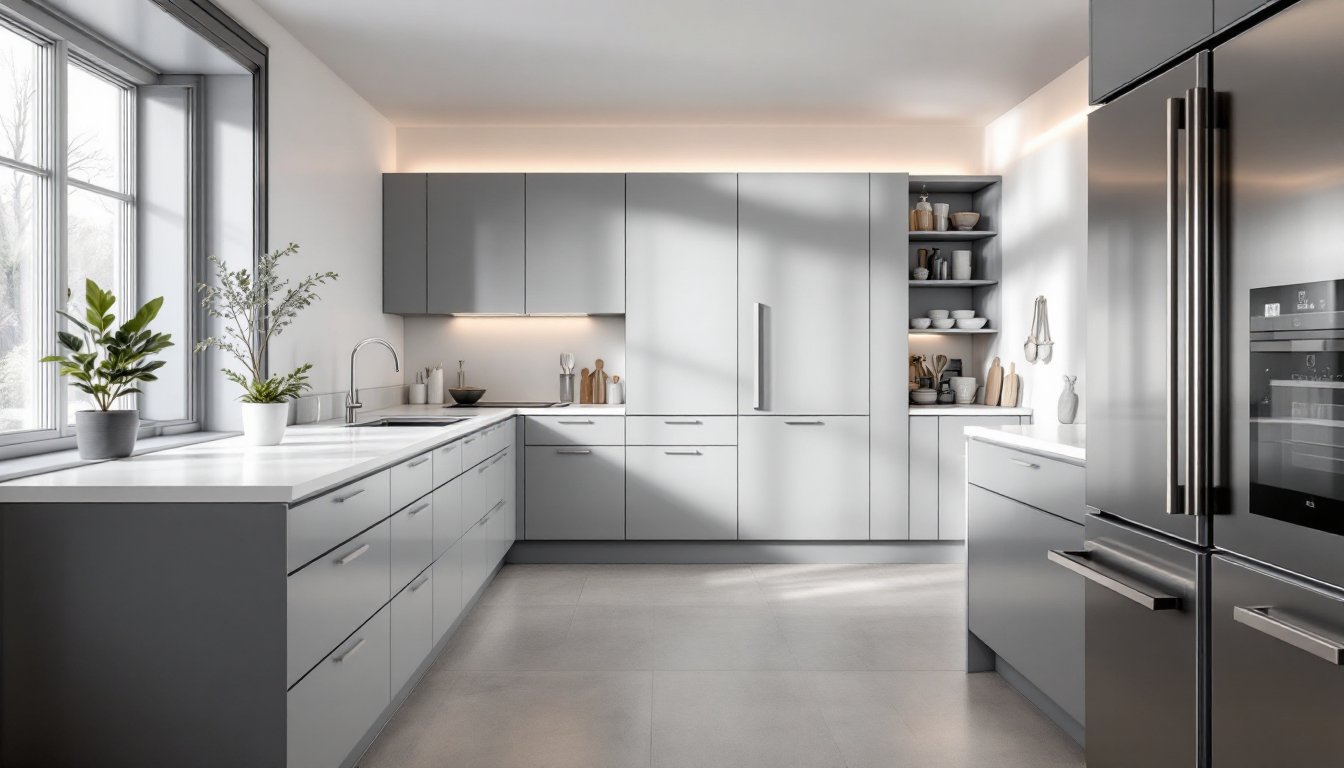
The aesthetic is restrained, no crown molding, no ornate corbels, no distressed finishes. Instead, expect handleless cabinets with push-to-open mechanisms, integrated appliances that disappear behind panels, and clean sightlines that emphasize horizontal planes. It’s a look that ages well because it avoids trend-chasing.
Finally, German kitchens often incorporate advanced storage solutions as standard: pull-out pantries with full-extension slides, corner units with swing-out carousels, and drawer dividers sized to actual utensil dimensions. These aren’t add-ons, they’re baked into the design from the start.
Core Principles of German Kitchen Design
Minimalist Aesthetics and Clean Lines
German design follows the “form follows function” principle borrowed from Bauhaus tradition. Cabinets feature slab doors (flat fronts with no raised panels or grooves), often in matte or high-gloss lacquer finishes. Cabinet heights align to create unbroken horizontal bands, and kickboards (toe kicks) are recessed and color-matched to disappear.
Handles are either integrated J-pulls machined into the cabinet edge or eliminated entirely with touch-latch systems. This creates a seamless look but requires quality hardware, cheap mechanisms stick or fail within a year.
Countertops are typically 12mm to 20mm thick, thinner than the chunky 40mm slabs popular in rustic kitchens. Materials lean toward engineered quartz or porcelain slabs rather than natural stone, valued for consistency in color and low maintenance. Backsplashes often extend floor-to-ceiling in the cooking zone, treated as a design feature rather than an afterthought.
Lighting is architectural: recessed LED strips under wall cabinets, integrated toe-kick lighting, and minimal pendant fixtures. The goal is even, shadow-free illumination that highlights materials, not decorative fixtures.
Superior Engineering and Quality Craftsmanship
German cabinets use dowel-and-cam construction or Domino joinery instead of pocket screws and glue. Cabinet boxes are often melamine-coated particleboard (not solid wood, which warps), but it’s high-density material rated for structural loads. Shelves are adjustable on metal shelf pins, and backs are 18mm thick and fully captured in dados, not stapled on.
Drawer systems from manufacturers like Blum or Hettich are standard. These aren’t the flimsy slides found in flat-pack furniture, they’re full-extension, soft-close units rated to carry 50-75 lbs without sagging. Installers need to follow torque specs when mounting: overtightening screws into particleboard strips threads.
Hinges are concealed European-style, with three-dimensional adjustment (up/down, left/right, in/out). This allows doors to be dialed in perfectly even if walls aren’t plumb. Cheaper hinges lose tension over time, causing doors to sag.
German kitchens often include BLUM AVENTOS lift systems for upper cabinets, allowing doors to swing up and out of the way. These require proper clearance above the cabinet and can’t be retrofitted easily into standard 30-inch-tall wall boxes.
Popular German Kitchen Layout Ideas
German design favors the work triangle concept but refines it into work zones: prep, cook, wash, store. Layouts are typically galley, L-shaped, or island-based, with an emphasis on keeping everything within a step or two.
Galley layouts work well in narrow spaces (8-10 feet wide). Cabinets line both walls, with a 42-inch minimum aisle for a single cook, 48 inches if two people share the space. Upper cabinets stop short of the ceiling, leaving a clean horizontal line rather than stacking to the crown.
L-shaped kitchens place the sink and cooktop on perpendicular walls, with the refrigerator closing the triangle. The corner is often fitted with a LeMans pull-out shelf or Magic Corner unit, spring-loaded trays that swing out in sequence, making deep corners accessible without crawling.
Island kitchens are popular in open-plan homes. The island houses the cooktop or sink, with modern design trends emphasizing a flush-mounted induction cooktop and a downdraft vent that pops up when needed, then retracts. Electrical and plumbing for islands require floor chases: if the home is on a slab, expect core drilling and conduit runs.
German kitchens avoid U-shaped layouts unless there’s ample space (12+ feet between opposing runs). Tight U-shapes create dead corners and feel cramped.
One underrated layout is the single-wall kitchen with a pocket door pantry. The main run is sleek and minimal, but a full-height pantry behind a sliding door (or a tall pull-out unit) provides bulk storage without visual clutter. This works in lofts or studios where the kitchen shares space with living areas.
Essential Features for an Authentic German Kitchen
Start with integrated appliances. Refrigerators, dishwashers, and even microwaves hide behind cabinet panels. Panel-ready appliances cost 20-30% more than freestanding models, but they’re essential to the look. Make sure the installer accounts for ventilation gaps, built-in fridges need 1-2 inches of clearance at the top and back or they’ll overheat.
Touch-to-open drawers and doors eliminate visible hardware. These use a mechanical push-latch or an electric servo motor (like SERVO-DRIVE). Mechanical systems are reliable but require a firm push: electric versions open with a light tap but add cost and need wiring. Both are sensitive to misalignment, so cabinets must be installed dead-level.
Full-height pantry units (84+ inches tall) with pull-out shelving replace the traditional walk-in pantry. These are typically 18-24 inches deep and fitted with tandem boxes or TANDEM pantry pull-outs that glide on soft-close slides. They hold an impressive amount but weigh 100+ lbs when loaded, so proper anchoring to wall studs is critical.
Undermount sinks paired with integrated drain boards cut into the countertop create a clean, one-plane work surface. The drain board is typically a grooved section that slopes toward the sink. This requires a CNC-cut quartz or porcelain slab, not something a countertop fabricator can easily field-cut.
Task lighting is built-in, not added later. LED strips mount under wall cabinets with a recessed aluminum channel and frosted diffuser lens. Wiring should be routed through the cabinet backs during installation: surface-mount power cords ruin the aesthetic. Homeowners looking to match this precision often explore broader renovation planning strategies before committing to cabinetry.
Waste sorting systems are standard. Expect a pull-out base cabinet with two or three bins (trash, recycling, compost) on full-extension slides. Some units include a lid that lifts automatically when the drawer opens. These require a minimum 18-inch cabinet width: 21 or 24 inches is better.
Color Schemes and Materials in German Kitchen Design
German kitchens lean toward neutral palettes: white, gray, taupe, black. Bold color, if used at all, appears as a single accent wall or cabinet run, not as a dominant theme. Matte lacquer finishes are popular: they hide fingerprints better than high-gloss but still offer a smooth, refined look. High-gloss finishes work well in small kitchens because they reflect light, but they show every smudge and require microfiber cloths and pH-neutral cleaners.
Wood veneer in oak, walnut, or ash provides warmth without going rustic. The grain is book-matched and finished with a matte UV-cured lacquer or oil-wax blend. Avoid polyurethane, it yellows and chips. Many inspiring design ideas for 2026 incorporate natural wood tones alongside sleek surfaces.
Countertops are typically engineered quartz (Caesarstone, Silestone) in solid colors or subtle veining, or large-format porcelain slabs that mimic marble or concrete. Thickness runs 12-20mm, not the chunky 40mm edge profiles seen in traditional kitchens. Edges are mitered or straight-cut, not bullnose or ogee.
Backsplashes are often slab-to-slab: the same material as the countertop extends up the wall, sometimes floor-to-ceiling. This eliminates grout lines and creates a monolithic look. Installation requires precision, any gap between slab and cabinet shows. Some designers use glass panels in smoked gray or bronze, back-painted and mounted with standoffs for a floating effect. Homeowners can explore detailed renovation examples to see how material choices impact the final result.
Flooring is typically large-format tile (24×24 inches or bigger), engineered hardwood in wide planks (7+ inches), or polished concrete. Grout lines are minimal: rectified tiles with 1/16-inch joints create a near-seamless look. Avoid small mosaics or busy patterns, they clash with the clean cabinetry.
Hardware, when visible, is stainless steel or brushed nickel, never brass or bronze unless the entire kitchen commits to a warm metal palette. Faucets are pull-down models with commercial-style spray heads or minimalist single-lever designs in a matching finish.
Safety note: High-gloss and glass surfaces can be slippery when wet. Use non-slip mats in sink and cooktop zones.
German design isn’t just about looks, it’s a system. Cabinets, appliances, and finishes are engineered to work together. Mixing a German cabinet line with big-box appliances and stock countertops dilutes the effect. If budget is tight, prioritize quality hardware and a cohesive material palette over square footage. A small, well-executed German kitchen outperforms a sprawling, poorly planned one every time. For broader inspiration on material choices and layout strategies, platforms like Houzz offer curated galleries, while Remodelista provides detailed sourcebooks on finishes and fixtures. Kitchen-focused sites such as The Kitchn also showcase real-world examples and practical advice for homeowners ready to commit to this design approach.