Table of Contents
ToggleAmmunition storage isn’t just about organization, it’s a critical safety responsibility that every gun owner must take seriously. Poorly stored ammo can pose fire hazards, become accessible to unauthorized users, and deteriorate prematurely, compromising performance and safety. Whether you’re a seasoned shooter with thousands of rounds or a casual gun owner with a few boxes in the closet, implementing proper storage strategies protects your household, preserves your investment, and ensures compliance with local regulations. This guide explores practical, tested solutions ranging from discreet everyday options to dedicated DIY builds, helping homeowners create storage systems that balance security, accessibility, and longevity.
Key Takeaways
- Proper home ammo storage protects your household from fire hazards, unauthorized access, and legal penalties while extending ammunition lifespan for decades.
- Store ammunition and firearms separately in secure containers, maintain temperatures between 55–85°F with 50% humidity, and use desiccant packs to prevent corrosion and performance degradation.
- Organize ammunition by caliber and type to prevent dangerous mix-ups—mixing similar rounds like .223 Remington and 5.56 NATO can cause firearm malfunctions and injury.
- DIY storage solutions like plywood cabinets ($40–60), under-stair drawers, or converted tool chests offer budget-friendly alternatives to expensive gun safes while maintaining security.
- Label all containers clearly with caliber, manufacturer, bullet type, and purchase date, then implement a first-in, first-out rotation system to monitor inventory and use older rounds first.
Why Proper Ammunition Storage Matters for Every Homeowner
Ammunition contains primer compounds and propellants that react poorly to heat, moisture, and physical impact. Modern smokeless powder is stable under proper conditions, but extreme temperatures or humidity can degrade performance and, in rare cases, create dangerous conditions. Corroded cartridges can jam firearms or cause malfunctions, while improperly stored rounds accessible to children or unauthorized users present obvious safety risks.
From a legal standpoint, some jurisdictions require ammunition to be stored separately from firearms or in locked containers, particularly in homes with minors. California, Massachusetts, and Connecticut have specific statutes around safe storage that carry criminal penalties if violated. Even in states without explicit laws, homeowner’s insurance policies may include clauses about securing firearms and ammunition, a house fire started by improperly stored ammo could void coverage.
Beyond compliance, proper storage extends ammunition lifespan significantly. Factory-loaded cartridges stored in climate-controlled environments with stable humidity can remain reliable for decades. Surplus military ammo from the 1950s and 1960s still fires consistently when it was sealed in proper containers. Conversely, ammo left in a damp basement or hot attic can corrode or degrade within months. The cost of replacing prematurely damaged ammunition often exceeds the investment in proper storage solutions.
Essential Safety Guidelines for Storing Ammo at Home
Store ammunition and firearms separately unless both are secured in the same heavy-duty safe designed for that purpose. This simple separation dramatically reduces unauthorized access risks and complies with most state-level safe storage laws. Children and untrained adults should never have independent access to either component.
Keep ammunition in its original factory packaging whenever possible. Those cardboard or plastic boxes aren’t just for retail display, they’re designed to cushion rounds, prevent contact corrosion between cartridges, and include critical headstamp and load data. If you’re consolidating opened boxes, use ammo cans (the military-surplus steel kind with rubber gaskets) or purpose-built plastic storage containers with compartments.
Never store ammunition near heat sources, water heaters, furnaces, or in direct sunlight. Primers can cook off at temperatures as low as 350°F, though household fires reach that threshold long before storage containers fail. The bigger everyday concern is heat cycling, repeated temperature swings degrade powder consistency and can weaken case neck tension.
Label everything clearly. Mark containers by caliber, manufacturer, bullet type (FMJ, hollow point, soft point), and date of purchase. This isn’t just organizational fussiness, mixing rounds or using degraded ammo can damage firearms or cause injury. Use a label maker or permanent marker on tape: avoid sticky labels that can peel and create confusion.
Temperature and Humidity Control
Ideal storage conditions mirror those for fine woodworking or electronics: temperatures between 55°F and 85°F with relative humidity around 50%. Basements can work if they’re climate-controlled and dry, but many older homes have damp foundation walls that push humidity above 60%, inviting corrosion.
Consider adding desiccant packs or rechargeable dehumidifiers (the silica gel canisters you can dry in an oven) inside ammo cans. Military surplus cans often include them, but they lose effectiveness over time. Replace or recharge every six months if you live in humid regions. For larger storage setups, a small electric dehumidifier in the storage room keeps the entire space dry.
Avoid attics in most climates. Summer temperatures in unconditioned attic spaces routinely exceed 130°F in southern states, and temperature swings between day and night accelerate powder breakdown. If attic storage is your only option, insulate the storage container and monitor internal temperature with a wireless thermometer.
Creative and Discreet Ammo Storage Solutions
Not everyone wants a gun safe dominating their bedroom or office, and renters often can’t install permanent fixtures. Discreet storage solutions hide ammunition in plain sight while maintaining security and accessibility.
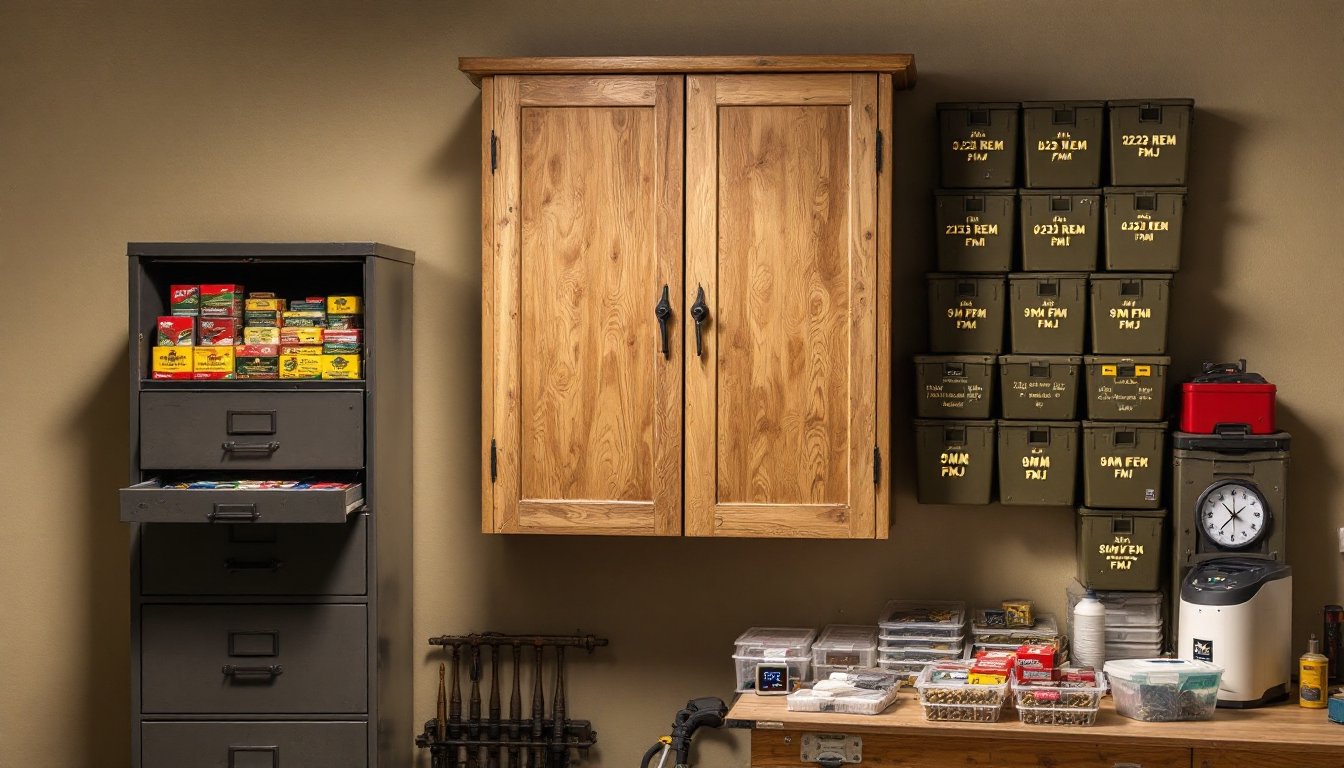
Converted furniture works surprisingly well. An old filing cabinet fitted with a keyed cam lock provides multiple drawers for organizing different calibers. Line drawers with foam or carpet remnants to prevent rattling. Vintage wooden filing cabinets blend into home offices or dens without screaming “gun stuff.” Just make sure the lock actually works, most filing cabinet locks are trivial to pick, so consider upgrading to a tubular lock or adding a padlock hasp if security is a primary concern.
Bench seats with lift-top storage in mudrooms or entryways offer concealment and convenience. Build or buy one with a piano hinge and install a keyed latch inside the front apron. Store ammo cans inside, and the exterior looks like any other entry bench. This works best for moderate quantities, a typical 18-inch-deep bench holds four to six surplus .50-cal ammo cans.
For smaller quantities, secure home safes designed for documents and valuables double as excellent ammo containers. Models with fire ratings protect against both theft and heat exposure. A compact 0.5 cubic foot safe tucked in a closet holds several hundred rounds across multiple calibers without drawing attention.
False-back cabinets in workshops or garages add a layer of security. Build or modify a standard wall cabinet so the interior is 4–6 inches shallower than it appears. The false back panel (secured with hidden magnets or cam locks) conceals a storage cavity perfect for ammo cans. This approach is more involved but offers genuine concealment even if someone opens the cabinet door.
DIY Ammo Storage Projects for Budget-Conscious Homeowners
Building your own storage solutions saves money and lets you customize capacity and security to your specific needs. These projects require basic carpentry skills and common tools.
Simple plywood ammo cabinet: Construct a wall-mounted lockable cabinet using 3/4-inch plywood for the case and 1/4-inch plywood or hardboard for the back. Cut the cabinet 36 inches tall, 24 inches wide, and 12 inches deep, enough for two rows of .50-cal ammo cans on adjustable shelves. Use cabinet-grade plywood if you’re staining: construction-grade works fine for paint. Install a hasp and padlock or a keyed cabinet lock on the door, and mount the cabinet to wall studs with 3-inch construction screws through the back panel. Total material cost runs $40–$60.
Under-stair pull-out drawers: If you have basement stairs, the triangular void underneath is wasted space. Build roll-out drawers on full-extension drawer slides rated for at least 100 pounds. Size each drawer to fit specific ammo can dimensions, most .50-cal cans measure roughly 11×5.5×7 inches. Frame the drawers with 1×4 pine and use 1/2-inch plywood for bottoms. Install a locking mechanism on the outermost drawer or add a hasp to the access panel if you’re concealing the entire installation behind a hinged door. This project makes use of otherwise dead space and keeps ammunition out of sight.
Converted tool chest: A rolling mechanic’s tool chest from Harbor Freight or similar outlets offers drawers, locks, and mobility for $150–$200. Line drawers with foam and organize by caliber. The advantage here is portability, you can roll it into a closet when not in use or move it between locations if needed. Gun storage ideas from experienced builders often incorporate similar repurposed industrial storage.
PVC tube storage for long-term preservation: For bulk storage of factory-sealed ammo you don’t plan to access frequently, cut 6-inch-diameter PVC pipe into lengths matching your ammo boxes, install screw-on cleanout caps on both ends, and seal with PVC cement. Add desiccant packs before sealing. These tubes are waterproof, crush-resistant, and stackable. Label the outside with caliber and date. This method is popular among preppers and works especially well for long-term storage in climate-controlled areas. Cost per tube is under $10.
Organizing Your Ammunition by Caliber and Type
Effective organization prevents dangerous mix-ups and speeds up access when you need specific ammo for range trips or hunting. Start by sorting everything by caliber, this is non-negotiable. Mixing .223 Remington and 5.56 NATO might seem harmless (they’re dimensionally similar), but pressure differences mean firearms chambered for .223 should not fire 5.56. Similar issues exist with .308 Winchester vs. 7.62 NATO, and countless pistol calibers with confusingly similar names.
Within each caliber, separate by bullet type and purpose. Keep defensive hollow points separate from practice FMJ rounds. Match ammo for competition or hunting stays in original boxes with load data intact, you need to know muzzle velocity, bullet weight, and ballistic coefficient for anything beyond casual plinking. If you reload, store reloaded ammunition separately from factory loads and label everything meticulously with load recipe, date, and components used.
Use compartmentalized storage bins or divided ammo cans for mixed caliber collections. Several manufacturers make plastic inserts sized for common calibers that fit inside .50-cal ammo cans, each insert holds multiple boxes and keeps everything upright and separated. For truly large collections, consider repurposing a hardware storage cabinet (the kind with dozens of small drawers for screws and bolts). Each drawer holds one caliber or load type, and clear front panels let you see inventory at a glance.
Carry out a first-in, first-out rotation if you shoot regularly. Older ammunition moves to the front of storage, and fresh purchases go in back. While properly stored ammo lasts decades, this habit ensures you’re always shooting the oldest reliable rounds first. Mark purchase dates on boxes or cans with a permanent marker, this simple step prevents mystery ammo from languishing in corners of your storage for years.
Inventory tracking matters more than most shooters realize. A simple spreadsheet or notebook listing caliber, quantity, manufacturer, and purchase date helps you monitor consumption, plan purchases during sales, and verify nothing’s gone missing. Update it quarterly or after every range trip.
Conclusion
Ammunition storage doesn’t require expensive commercial solutions or complicated installations. Whether you’re converting furniture, building simple cabinets, or repurposing industrial storage, the priorities remain consistent: keep ammo secure from unauthorized access, protect it from environmental damage, and organize it to prevent dangerous mix-ups. Start with the basics, proper containers, climate control, and clear labeling, then scale your storage as your needs and budget allow. Every responsible gun owner has an obligation to store ammunition safely, and with the ideas outlined here, that responsibility becomes straightforward and manageable.