Table of Contents
ToggleSmall changes make big differences in bathrooms. A cluttered vanity, dated fixtures, or poor lighting can turn a daily routine into a chore. But simple design choices, neutral colors, smart storage, clean lines, can transform even a cramped half-bath into a space that feels open, calm, and functional. These aren’t complicated renovations requiring permits or weeks of downtime. They’re practical updates that most DIYers can tackle over a weekend or two, using common tools and off-the-shelf materials. This guide breaks down six straightforward strategies to refresh a bathroom without blowing the budget or demo-ing down to the studs.
Key Takeaways
- Simple bathroom design ideas focus on durability, ease of cleaning, and intentional choices that avoid trendy elements that quickly feel dated.
- Neutral color palettes like white, soft gray, and warm beige make bathrooms feel larger and calmer by reflecting light, while adding warmth through natural wood or matte black accents prevents the space from feeling sterile.
- Smart storage solutions including recessed medicine cabinets, floating vanities, and open shelving eliminate clutter and make small bathrooms feel less cramped without requiring a full renovation.
- Minimalist fixtures with single-handle faucets, frameless mirrors, and unified hardware finishes create a cohesive, uncluttered look that’s easier to maintain.
- Layered lighting with ambient, task, and accent elements makes bathrooms safer, more functional, and visually larger, with vanity sconces eliminating shadows better than overhead-only fixtures.
- Most simple bathroom design updates can be completed by DIYers over a weekend using common tools and off-the-shelf materials, without permits or extensive downtime.
Why Simple Bathroom Design Works Best
Bathrooms get heavy use. Moisture, heat, and tight quarters mean every surface and fixture takes a beating. Overdesigned spaces with fussy details, high-maintenance finishes, or trendy elements that’ll feel dated in two years just create more work.
Simple design prioritizes durability and ease of cleaning. Flat-panel cabinets wipe down faster than ornate ones. Large-format tiles mean fewer grout lines to scrub. A single finish on hardware (all brushed nickel, all matte black) looks cohesive without requiring constant coordination.
It’s also more forgiving for DIYers. Installing a floating vanity is easier than wrestling a heavy furniture-style piece into place. Painting walls in one neutral shade takes less taping and cutting-in than an accent wall.
Finally, simple doesn’t mean boring. It means intentional. Each element, color, fixture, material, has a clear purpose. The result is a bathroom that feels deliberate, not cluttered. And when it’s time to sell, neutral, well-maintained bathrooms appeal to the widest range of buyers.
Neutral Color Palettes That Create Calm
Color sets the tone. Bathrooms benefit from palettes that feel clean and open, not busy or claustrophobic.
White, soft gray, and warm beige are go-tos for walls and large surfaces. They reflect light, making small bathrooms feel larger. Benjamin Moore’s White Dove (OC-17) and Sherwin-Williams’ Agreeable Gray (SW 7029) are popular because they read neutral in both natural and artificial light, no surprise green or pink undertones.
Paint coverage averages 350–400 square feet per gallon for most bathroom paints. Use a semi-gloss or satin finish: both resist moisture better than flat paint and wipe clean easily. Two coats over properly primed drywall or previously painted surfaces is standard.
For tile, subway tile (3×6 inches) in white or light gray remains a workhorse. It’s affordable, widely available, and timeless. Larger formats like 12×24-inch porcelain planks reduce grout lines and speed installation. Stick to neutral grout, light gray or white for light tile, charcoal for dark tile, to keep the look cohesive.
If the space feels too sterile, add warmth with natural wood tones (a teak bath mat, bamboo accessories) or matte black accents (faucet, towel bar). These tweaks add depth without overwhelming the palette. Many design inspiration platforms showcase how neutral bathrooms use texture and finish variation to stay interesting.
Smart Storage Solutions for Clutter-Free Bathrooms
Clutter kills the calm vibe. Toothpaste, razors, hair products, they pile up fast. Built-in storage solves this without eating floor space.
Recessed medicine cabinets fit between wall studs (typically 14.5 inches wide in a standard 16-inch on-center stud bay). They provide hidden storage and eliminate the need for a bulky mirror cabinet. Install them at eye level (about 60–65 inches to the center for most adults). You’ll need a reciprocating saw or oscillating multi-tool to cut drywall, and a stud finder to locate framing. If you hit a stud where you want the cabinet, either shift the location or frame in a new opening, messy, but doable.
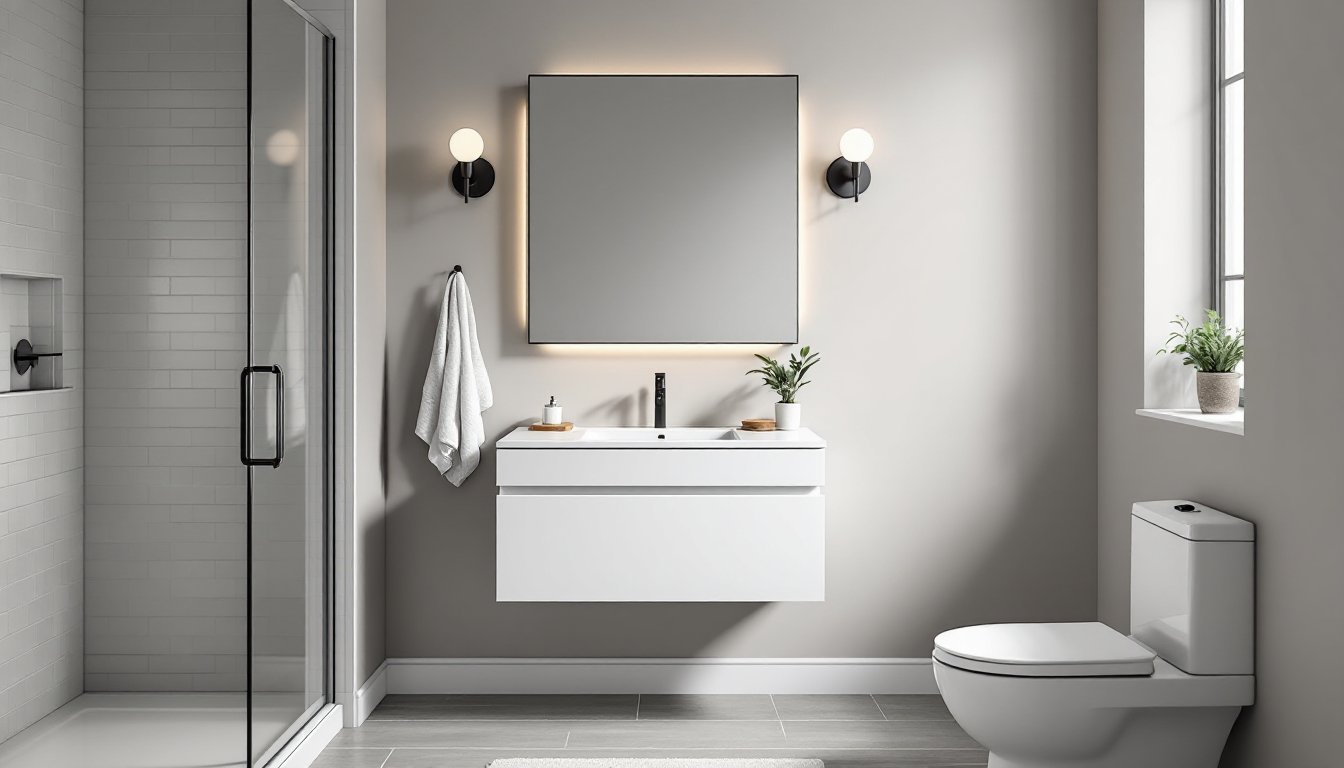
Floating vanities open up floor space and make small bathrooms feel less cramped. They’re mounted to wall studs with a ledger board or heavy-duty brackets rated for the vanity’s weight plus countertop and contents. Use at least two 3-inch construction screws into studs for each bracket. Standard vanity heights are 32–36 inches: floating styles often sit slightly higher (34–36 inches) for a modern look.
Niches in the shower are ideal for shampoo and soap. Frame them during a tile install between studs, typically 14×14 inches or 14×28 inches. Line with a waterproof membrane (Schluter KERDI, RedGard) before tiling. If you’re not opening walls, corner caddies or tension-pole shelves work fine, just avoid suction-cup units that fail in a few months.
Open shelving above the toilet or beside the vanity adds storage without closing in the room. Use 1×8 or 1×10 boards (actual dimensions 0.75×7.25 or 0.75×9.25 inches) with simple brackets. Keep daily-use items in closed storage: open shelves are for folded towels and decor.
Minimalist Fixtures and Hardware Choices
Fixtures are the jewelry of a bathroom. Clean-lined, modern pieces keep the space feeling uncluttered.
Single-handle faucets are simpler to use and maintain than two-handle models. Look for ceramic disc cartridges: they last longer than compression or ball valves. WaterSense-labeled faucets (1.5 GPM or less) save water without sacrificing pressure. Installation is straightforward: most mount through one or three holes in the countertop or sink deck. Use plumber’s putty or a rubber gasket under the base, hand-tighten the mounting nut from below, then connect supply lines.
Wall-mounted faucets offer a sleek look and free up counter space, but require roughing-in behind the wall. Valves must be installed at the correct depth (usually 2–3 inches behind finished tile) and level. Not a beginner project unless you’re comfortable cutting into walls and soldering copper or using PEX connections. If your municipality requires a licensed plumber for supply line work, check local code before starting.
For hardware (towel bars, toilet paper holders, robe hooks), stick to one finish throughout: brushed nickel, matte black, or polished chrome. Mixing finishes rarely looks intentional in a small room. Install towel bars into studs or use heavy-duty drywall anchors (toggle bolts or screw-in anchors rated for at least 50 pounds). A loose towel bar yanked out of drywall is a common DIY fail.
Frameless mirrors are simpler and more modern than framed ones. Mount with mirror clips or adhesive (Loctite PL530 mirror adhesive). If going adhesive-only, the mirror must be under 30 pounds and the wall must be smooth, clean, and dry. Many homeowners blend these approaches with renovation strategies that balance aesthetics and DIY-friendliness.
Affordable Flooring and Wall Options
Flooring and wall treatments set the foundation, literally, for the rest of the design.
Luxury vinyl plank (LVP) is the budget-friendly favorite. It looks like wood or stone, handles moisture well, and installs as a floating floor over existing vinyl or concrete (as long as the subfloor is level within 3/16 inch over 10 feet). Most LVP uses a click-lock system: no glue, no nails. Expect to pay $2–$5 per square foot for decent quality. Underlayment with a moisture barrier is smart in full baths: some LVP includes it attached.
Porcelain tile (12×24 or larger format) is more durable and water-resistant than ceramic, especially for floors. It’s harder to cut, use a wet saw with a diamond blade, not a snap cutter. Layout matters: dry-fit tiles first, starting from the center of the room and working outward, to avoid ending with tiny slivers against a wall. Use unsanded grout for joints under 1/8 inch, sanded for wider. Seal grout after it cures (usually 72 hours) with a penetrating sealer.
For walls, large-format tiles (like 12×24-inch or even 24×48-inch slabs) reduce grout maintenance and create a modern look. Thin-set mortar applied with a 1/4×1/4-inch notched trowel is standard for walls: back-butter large tiles to ensure full coverage. Always use a waterproof membrane (sheet like Schluter KERDI or liquid like RedGard) behind tile in wet areas. Skipping this step invites mold and rot.
Beadboard paneling (real wood or PVC) adds texture to the lower half of walls. It’s affordable ($0.50–$2 per linear foot for PVC), moisture-resistant, and hides imperfect drywall. Install with construction adhesive and finish nails, then caulk seams and paint. Cap with a simple chair rail. Those considering broader updates often explore beginner-friendly renovation projects that layer multiple techniques.
Lighting Ideas to Brighten and Expand Your Bathroom
Good lighting makes a bathroom safer, more functional, and visually larger. Most bathrooms are under-lit or rely solely on a single overhead fixture.
Layered lighting is the fix: ambient (overhead), task (vanity), and accent (if desired). For ambient, an LED flush-mount or recessed canister provides even, shadow-free light. LED bulbs (9–12 watts, 800–1,100 lumens) are energy-efficient and long-lasting. Color temperature matters: 3000K (warm white) to 4000K (neutral white) works best in bathrooms. Anything cooler feels clinical.
Vanity lighting should flank the mirror at eye level (about 60–65 inches from the floor) or run across the top. Sconces on either side eliminate shadows on the face, much better for grooming than a single overhead light. Use 40–60-watt-equivalent bulbs per sconce. If top-mounting a bar light, aim for 75–100 watts total. Wire to a separate switch from the overhead light if possible: it’s more flexible.
Installing new fixtures often requires running new wire. If you’re comfortable working in a breaker panel and pulling wire through walls or attic space, it’s doable. Otherwise, hire a licensed electrician. NEC (National Electrical Code) requires GFCI protection for bathroom outlets and, in many jurisdictions, for lighting circuits within a certain distance of water sources. Code varies, so check local requirements.
Dimmer switches add ambiance and save energy. Use LED-compatible dimmers: older incandescent dimmers can cause LED flicker or hum. Installation is simple: turn off the breaker, remove the old switch, connect the dimmer’s wires (usually black to hot, white to neutral, green to ground), and mount.
Mirrors amplify light. A large mirror opposite a window or next to sconces bounces light around the room. Frameless or thin-framed mirrors keep the look simple. Homeowners interested in cohesive aesthetics often reference current interior design trends to align lighting choices with broader home styling. Platforms like Homedit and Remodelista regularly feature bathrooms where lighting transforms compact spaces into bright, inviting retreats.
Conclusion
Simple bathroom design isn’t about cutting corners, it’s about making smart, intentional choices that prioritize function, durability, and ease of maintenance. Neutral palettes, streamlined fixtures, smart storage, and layered lighting deliver results that look polished and stand up to daily use. Most of these updates are well within reach for a confident DIYer with a weekend, a few tools, and attention to detail.